Howard County was the Home of the Longest Operating Vineyard in Colonial America
By: Jerry Ueckermann
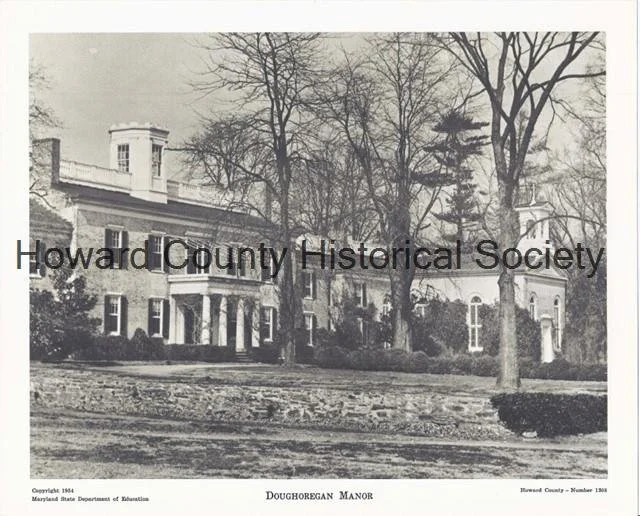
In 1770 or 1771 Charles Carroll of Annapolis began a vineyard in what is now Howard County at his estate Doughoregan.[i] Carroll planted Rhenish, Claret, Burgundy and Virginia grapes to determine which were best suited to local conditions. After Carroll’s death in 1782, his son Charles Carroll of Carrollton (the signer of the Declaration of Independence) continued the vineyard. The Carrolls brought vine-dressers from France to tend to it. A 1796 visitor reported that there was a small vineyard and that a few indigenous grapes had been tried.[ii] By 1797, however, the vineyard was evidently abandoned.[iii]
Many wealthy men in Colonial America tried to grow wine grapes, but with little success. Transplanted European vines had no resistance to American diseases; native varieties had resistance, but their grapes produced wine with odd flavors. Hybrids of European and native vines had some disease resistance but still produced unsatisfactory wine.[iv]
Despite its ultimate failure, the vineyard at Doughoregan has been recognized as the longest operating pre-Revolutionary War vineyard in America.[v] Also, a native vine planted by the Carrolls was still alive in the 1980s and may still be living.[vi] In 1971 a new vineyard was planted at Doughoregan, which produced excellent wine.[vii]
Although wine was hard to produce in eighteenth century Howard County, residents could imbibe locally produced whiskey and cider. Malt houses, stills and cider presses are well documented in early area records.[viii] Additionally, some area residents kept bee hives, so mead was probably being made as well.[ix]
BUT CAN SOMEONE FIND US AN OLD BREWERY? While there are hints that some home brewing may have gone on in early Howard County,[x] no documentation referring to a brew house has been found. The earliest brewery that has been found in the county is the microbrewery that opened in 1995 at Bare Bones on Route 40 in Ellicott City.[xi]
HCHS Collection
[1] “A Lost Copy-Book of Charles Carroll of Carrollton”, Maryland Historical Magazine, vol 32, p. 193, 211-213 (1937).
[1] DuFour, John James, The American Vine-Dresser’s Guide, (Cincinnati: S.J. Browne, 1826), p. 23; McGrew, J.R., “Winemaking in Maryland”, American Wine Society Journal, vol 9, no. 4 (Fall 1977) pp. 60-62.
[1] Liancourt, la Rochefoucault, Travels Through the United States of North America, vol 3, (London: R. Phillips, 1799) p. 585.
[1] McGrew, “Winemaking in Maryland”.
[1] McGrew, “Winemaking in Maryland”; Pinney, Thomas. A History of Wine in America: From the Beginnings to Prohibition, (Berkeley: University of California Press, 1989), http://ark.cdlib.org/ark:/13030/ft967nb63q/ , p. 84.
[1] Pinney, A History of Wine in America: From the Beginnings to Prohibition, chapter 4, footnote 4.
[1] Wagner, Phillip M., Grapes into Wine: The Art of Wine Making in America, (New York: Knopf, 1976), p. 36.
[1] See, e.g., 1798 Elkridge tax list on which John Corneilius has one malt house and one still house with three stills, and John Shipley, Sr. has a still house. The 1773 will of Alexander Warfield refers to a location “where my people used to press cyder”. Many probate inventories list cider mills.
[1] See, e.g., 1796 inventory of estate of Joseph White, Sr.
[1] An early land patent was Brown’s Hopyard (1719), and hops are listed among items owned in some early Anne Arundel probate records (although it has not been determined if these records relate to residents of the Howard County area). Presumably the malt produced in malt houses for use in stills could also be used to brew beer.
[1] Baltimore Sun, (Howard County edition), Dec. 11, 1995, p. 3B.